<?xml version="1.0" encoding="UTF-8"?>
<feed xmlns="http://www.w3.org/2005/Atom" xmlns:dc="http://purl.org/dc/elements/1.1/">
  <link href="https://brandontoner.ca/rxblog.xml" rel="self" type="application/atom+xml"/>
  <author>
    <name>Brandon Toner</name>
  </author>
  <id>https://brandontoner.ca/rxblog.xml</id>
  <title>Brandon Toner: Pharmacy</title>
  <published>2023-11-19T08:00:00-04:00</published>
<entry>
        <id>https://brandontoner.ca/medreviewreform</id>
        <link href="https://brandontoner.ca/medreviewreform"/>
        <title>The Model of "Basic" vs "Advanced" Medication Reviews is Broken</title>
        <published>2023-11-29T21:00:00-04:00</published>
        <updated>2023-11-30T09:00:00-04:00</updated>
    <content type="html">
        <![CDATA[
                <p>In Nova Scotia pharmacy, there are two tiers of medication reviews — basic and advanced<sup><a href="#fn1-13156" id="fnr1-13156" title="see footnote" class="footnote">1</a></sup>.</p>

                <p>Basic medication reviews is a more cursory review of medications to ensure the patient's medication list is up-to-date, they understand what each medication is for, and any drug-therapy problems that are discovered are documented and resolved by the pharmacist. </p>
                
                <p>Advanced medication reviews are a more comprehensive assessment of the patient's medication history and health status. It includes a medication reconciliation (what the patient is actually taking), but extended into a full pharmacotherapy workup and subsequent care planning for each medical condition the patient is managing. </p>
                
                <p>With the introduction of pharmacy technicians into the pharmacy workforce, though, these services need to be revisited to enable higher quality pharmaceutical care in the community setting. </p>
                
                <h2>A proposed alternative</h2>
                
                <ul>
                <li><p>Medication Reconciliation (RPT or RPh)</p></li>
                <li><p>Assessment & Care Planning* (RPh)</p></li>
                <li><p>Complex Assessment & Care Planning* (RPh)</p></li>
                <li><p>Chronic Disease Management (Follow-up Evaluations) (RPh)</p>
                
                <p>*Note: Basic and Advanced Care Planning Services should include a med rec as part of the service, though this component could be completed by an RPT.</p></li>
                </ul>
                
                <h2>Why this is better</h2>
                
                <p>It is often necessary to &quot;clarify the record&quot; in pharmacy practice. In the process of providing <a href="https://brandontoner.ca/ecm2">routine care</a> for patients, we may determine that the patient's profile seems disordered — that there is uncertainty around the patient's actual medication-taking behaviours. A <strong>medication reconciliation</strong> in needed - and should be able to be completed by a registered technician. </p>
                
                <p>It is also possible that a <a href="https://brandontoner.ca/pdtp">potential drug therapy problem</a> is identified, and further investigation is warranted to workup the patient and create a plan for resolution if necessary. A <strong>care planning appointment</strong> is needed. A &quot;complex&quot; care planning activity should be included in the fee schedule to account for the difference in time, effort, and skill required to navigate patient cases involving significant poly-therapy and multiple concurrent conditions<sup><a href="#fn2-13156" id="fnr2-13156" title="see footnote" class="footnote">2</a></sup>.</p>
                
                <p>It is also possible that the patient will require ongoing care and monitoring following the initial care planning encounter due to the presence of uncontrolled or sub optimally managed chronic diseases. <strong>Chronic disease follow-up evaluations</strong> are needed. The number of followup assessments the patient is eligible for should be determined based on the presence of <em>unresolved drug therapy problems</em>, or more crudely, a set number of followups based on the conditions being managed. </p>
                
                <p>This suite of services is a <em>small</em>, but productive step towards enabling an <a href="https://brandontoner.ca/ecm">enhanced standard of pharmaceutical care</a> in community pharmacies for patients who need it. This is especially important service infrastructure in the context of our current primary care crisis, where many Nova Scotias are without a family practice<sup><a href="#fn3-13156" id="fnr3-13156" title="see footnote" class="footnote">3</a></sup>. </p>
                
                <div class="footnotes">
                <hr />
                <ol>
                
                <li id="fn1-13156">
                <p><a href="https://brandontoner.ca/files/Pharmacy-Guide-2023.pdf">MSI Pharmacy Guide (September 2023)</a> <a href="#fnr1-13156" title="return to article" class="reversefootnote">&#8617;&#xFE0E;</a></p>
                </li>
                
                <li id="fn2-13156">
                <p>&quot;Complex&quot; was chosen as language here, as it points more specifically to the <em>complexity</em> of care (more components), vs the <em>difficulty</em> or <em>skill required</em> that may be implied by &quot;basic&quot; vs &quot;advanced&quot;. <a href="#fnr2-13156" title="return to article" class="reversefootnote">&#8617;&#xFE0E;</a></p>
                </li>
                
                <li id="fn3-13156">
                <p><a href="https://public.tableau.com/app/profile/nova.scotia.health/viz/ActionforHealth-PublicReporting/Overview">Nova Scotia Health: Action for Health - Public Reporting</a> <a href="#fnr3-13156" title="return to article" class="reversefootnote">&#8617;&#xFE0E;</a></p>
                </li>
                
                </ol>
                </div>
        ]]>
    </content>
</entry>
<entry>
        <id>https://brandontoner.ca/ecm2</id>
        <link href="https://brandontoner.ca/ecm2"/>
        <title>Active Monitoring and Formal Care Planning Distinguish Enhanced Care from Usual Care</title>
        <published>2023-11-28T21:00:00-04:00</published>
        <updated>2023-11-28T21:08:00-04:00</updated>
    <content type="html">
        <![CDATA[
                <p>In a previous post, I described <a href="https://brandontoner.ca/ecm">a model of escalating patients to &quot;Enhanced Care&quot;</a> to help resolve drug therapy problems using a more formalized pharmaceutical care process. </p>    

                <p><strong>A key question that follows: What are the characteristics of &quot;usual/routine care&quot;?</strong> </p>
                
                <p>During routine dispensing in a community pharmacy, there is seldom time or workflow affordances to conduct continuous, comprehensive medication management. Rather, care often looks like receiving prescriptions from physicians, NPs and other providers, counselling patients about safe and effective use of medications and conditions, and screening for <a href="https://brandontoner.ca/pdtp">potential problems with drug therapy</a> that may requires further assessment or intervention.</p>
                
                <p><em>Once a potential drug therapy problem is identified</em>, it can be managed in a couple of ways:</p>
                
                <ul>
                    <li>Dismissed as not-clinically-relevant</li>
                    <li>Resolved informally through brief discussion with the patient or prescriber.</li>
                    <li>Through the delivery of a targeted non-dispensing service to resolve the issue (e.g. adapt the dose)</li>
                    <li>Through engaging the patient in more complex and generalized care planning services (e.g. advanced medication review, chronic disease management, Bloom)</li>
                </ul>

                <p>Enhanced Care is care involving the maintenance of a formal care plan that is explicitly documented and evolves over the course of several patient encounters as part of an active monitoring plan. It would be initiated though AMR, CDM, or similar as the "initial assessment" from which the followup evaluations would be based on.</p>
                
                <p>All patients may not require this degree of formalized pharmacy-led care, and patients enrolled Enhanced Care may be discharged back to usual care once drug therapy problems are resolved and the patient's health status is well-enough controlled. For patients that have a family practice, they would continue receiving continuous, comprehensive medication management services from their primary care practitioner. </p>
                
                <p>Further expansion of this idea could explore what patients may be good candidates for Enhanced Care services, how to optimize transitions in care (detection, enrolment, and discharge), and how to manage patients who are &quot;unattached&quot; (those without a family practice and therefore have no most-responsible provider providing primary care services on an ongoing basis).</p>
        ]]>
    </content>
</entry>
<entry>
        <id>https://brandontoner.ca/ecm</id>
        <link href="https://brandontoner.ca/ecm"/>
        <title>Using Escalation to "Enhanced Care" to Manage Complex Patient Cases in Community Pharmacy</title>
        <published>2023-11-28T12:00:00-04:00</published>
        <updated>2023-11-28T13:00:00-04:00</updated>
    <content type="html">
        <![CDATA[
                <p>During routine pharmacy care in a community pharmacy, we often come across patient cases where there are a few potential drug therapy problems that are not yet resolved. A chronic disease may not be optimally controlled, indications for therapy may be unclear, or patient adherence and pickup habits may not appear to align with their care plan.</p>

                <p>These <a href="https://brandontoner.ca/pdtp">potential drug therapy problems</a> are a good signal that the patient may benefit from pharmacy care services to clarify the medication record and work towards defining and resolving actual drug therapy problems.</p>
                
                <p>An excellent starting place may be an advanced medication review or a more comprehensive assessment of a particular medical condition (as in chronic disease management). The purpose of these &quot;initial assessments&quot; is to <em>clarify</em> and assess the patients current status of care and relevant history. Afterwards, followup care is needed to follow-through on the recommendations and make sure that our interventions <em>actually worked</em>. </p>
                
                <p>For cases where more detailed followup care is necessary, it is worthwhile to transition the patient into a defined program to give additional structure to the followup assessments. In Nova Scotia, we have the Bloom Program as a good example of this system. Patients may be enrolled in the Bloom Program if they have a drug therapy problem associated with a mental health condition. Once enrolled, they are followed by the pharmacist for ~6 months to work towards resolving problems related to their medications and improving the status of their mental health. Similar, is the Chronic Disease Management model used by the Community Pharmacy Primary Care Clinic (CPPCC) pilot project led by PANS. Except within CDM, the conditions are hypertension, diabetes, asthma, COPD and dyslipidemia instead of mental health. Really, both of these systems are pointing at a more generic &quot;Enhanced Care&quot; model to assist in the management of complex patient cases using defined programs. </p>

                <p>By explicitly enrolling the patient in an enhanced care program, we are shifting our focus to a more longitudinal and clinic-based model of care.</p>
                
                <p>Once the patient's condition has been stabilized, control has been achieved, or the drug therapy problems have been resolved, they can be discharged from the program and returned to usual pharmacy care for ongoing care and monitoring. </p>
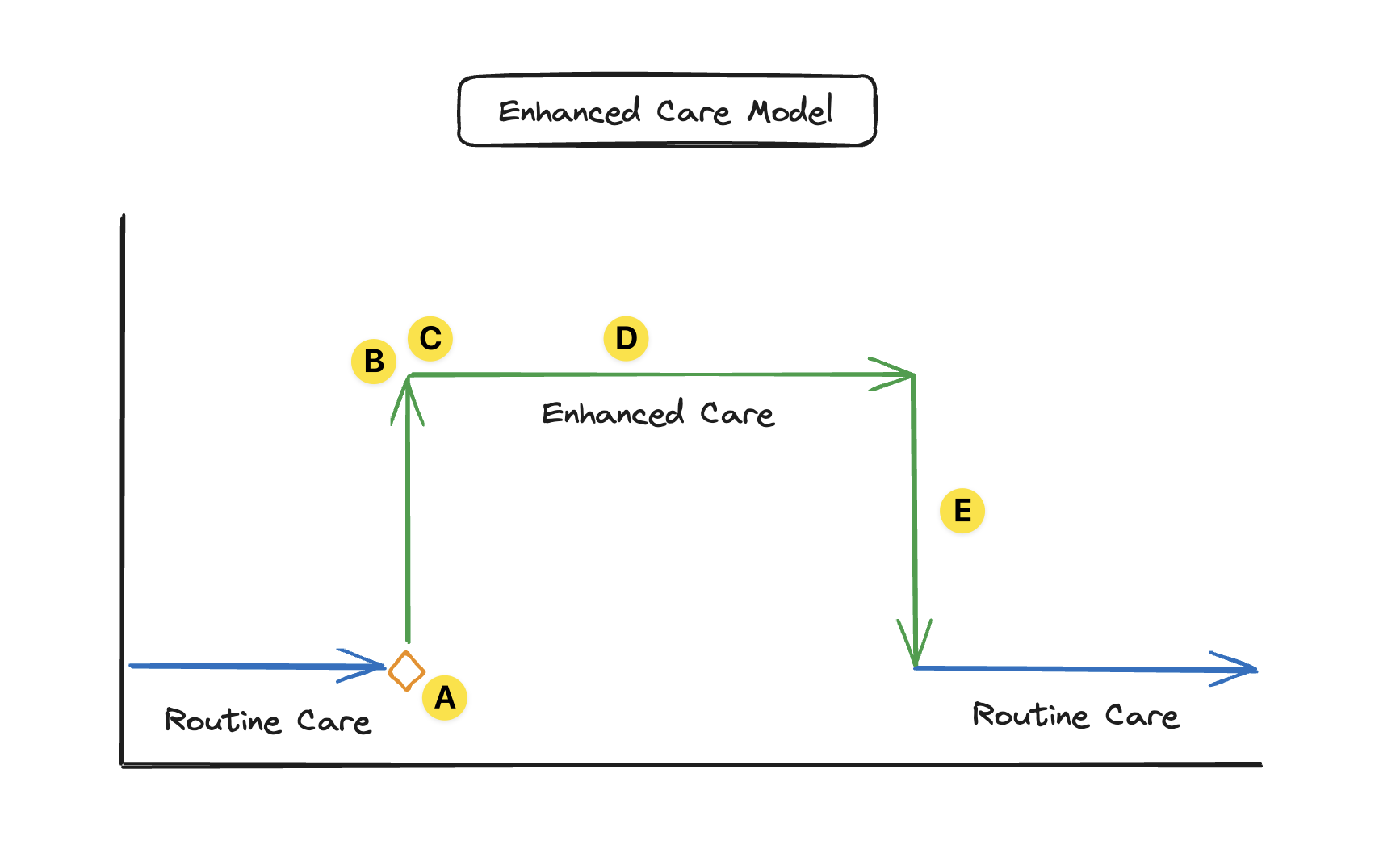
                <img src="/images/ecm.png" alt="Enhanced Care Model">Diagram illustrating the Enhanced Care model</img>

                <p><strong>Process:</strong></p>

                <ul>
                    <li>(A) Identify pDTP(s)</li>
                    <li>(B) Pharmacotherapy Workup (Assess, Identify DTPs)</li>
                    <li>(C) Create care plan (interventions and monitoring plan)</li>
                    <li>(D) Follow-up Evaluations (ongoing assessment &amp; care planning within Enhanced Care program)</li>
                    <li>(E) Discharge back to routine/usual care</li>
                </ul>
        ]]>
    </content>
</entry>
<entry>
        <id>https://brandontoner.ca/eodb</id>
        <link href="https://brandontoner.ca/eodb"/>
        <title>Book Lighter Appointments at the End of the Day</title>
        <published>2023-11-27T14:00:00-04:00</published>
        <updated>2023-11-27T14:00:00-04:00</updated>
    <content type="html">
        <![CDATA[
                <p>When using Appointment-Based Pharmacy (ABP) to deliver non-dispensing services, it may be worthwhile to consider the optimal timing for different service bookings. </p>

                <p>Longer, more complicated services may be more likely to go over the allotted appointment time, and may require more charting after the appointment to complete the encounter. For this reason, it is best to avoid scheduling them at the end of the day. </p>
                
                <p>Instead, consider booking shorter, more controlled and predictable appointments at the end of the day. </p>
                
                <p>Benefits:</p>
                
                <ul>
                <li>More likely to end clinic on-time.</li>
                <li>More likely to finish charting on-time.</li>
                <li>Reserves more &quot;in-depth&quot; or &quot;challenging&quot; appointments for times when your clinician battery is more fully charged.</li>
                </ul>
                
                <p>To implement this strategy, work with the person responsible for booking appointments to identify and schedule &quot;lighter&quot; appointments at the end of the day. </p>
                
                <p>While this might not work for all scenarios — this sets up a &quot;smart default&quot; to use when there are no other constraints on selecting an appointment time. </p>

                <hr>
                
                <p><em>Note: This idea was inspired by an email conversation with Glenn Rodrigues.</em></p>
        ]]>
    </content>
</entry>
<entry>
        <id>https://brandontoner.ca/pdtp</id>
        <link href="https://brandontoner.ca/pdtp"/>
        <title>Using Potential Drug Therapy Problems (pDTP) to Prime for Care Planning Services</title>
        <published>2023-06-08T08:00:00-04:00</published>
        <updated>2023-06-08T08:00:00-04:00</updated>
    <content type="html">
        <![CDATA[
            <p>Drug Therapy Problems (DTPs) are the pharmacist's assessment of issues related to drug therapy that are in the way of achieving the patient's goals of therapy. </p>

            <p>Identifying drug therapy problems relies on conducting a comprehensive patient assessment (elicit information). </p>

            <p>This works well if the pharmacist has a planned assessment appointment with the patient. It becomes more challenging during ongoing care and monitoring activities within a community pharmacy where there may not always be routine clinical appointments scheduled with the pharmacist for each patient (like in a physician's clinic).</p>

            <p>Community pharmacists are in an excellent position to <em>monitor</em> ongoing medication use. By assessing the patient's dispensing record, in combination with the clinical information documented on file, and information gathered through interactions with the patient, the pharmacist can identify <em>potential</em> drug therapy problems — <em>clues</em> that there may be an actual drug therapy problem.</p>

            <p>What is the difference between a potential and an actual drug therapy problem? — <em>clarity</em> and <em>depth of assessment</em>.</p>

            <p><strong>Example:</strong> </p>

            <p>While processing a routine request for medication refills, you notice that it's been a while since Mrs. Smith has filled her amlodipine (it's been 120 days since she filled a 90 days supply). </p>

            <p><em>Is there a drug therapy problem here?</em></p>

            <p>We don't know for sure! We need more information. </p>

            <ul>
            <li>Did she have a stockpile at home that she's been working through?</li>
            <li>Was the medication intentionally stopped by a prescriber?</li>
            <li>Was she instructed to use a lower dose?</li>
            <li>Has she been experiencing an adverse effect and has chosen to take less?</li>
            <li>Is she having trouble affording it?</li>
            <li>Does she have reservations about taking the medication?</li>
            <li>Does she forget to take it periodically?</li>
            </ul>

            <p>There are many possible DTPs and non-DTPs here, and the only way to know for sure is to assess the patient to get more information.</p>

            <p><strong>So, why are pDTPs important?</strong> </p>

            <p>Potential drug therapy problems:</p>

            <ul>
            <li>formalize the recognition of potentially problematic medication usage patterns</li>
            <li>justify the delivery of non-dispensing pharmacy services and more detailed patient assessment</li>
            <li>focus ongoing monitoring attention and surveillance</li>
            <li>create opportunities for internal and external collaboration</li>
            </ul>

            <p>While <em>actual</em> drug therapy problems suggest changes to the patient <em>care plan</em>, <em>potential</em> drug therapy problems suggest further investigation of the area of concern.</p>

            <p>Actual DTP: &quot;Mrs. Smith is experiencing periodic orthostatic hypotension due to excessive antihypertensive use (amlodipine 10mg once daily, taken inconsistently due to dizziness) and <em>may benefit from a dosage reduction</em>.&quot;</p>

            <p>Potential DTP: &quot;Potential non-adherence: amlodipine (~30 days late on 90 day supply) — <em>may benefit from further assessment at next opportunity</em>&quot;</p>

            <p><strong>Integrating pDTPs into Community Practice</strong></p>

            <p>Documenting pDTPs and programming them to alert pharmacy staff during the appropriate context empowers the team to clarity the patient record and identify any actual DTPs that the patient may be experiencing. </p>

            <p>pDTPs could be reviewed during Med Review encounters, or during Prescription Renewals. </p>

            <p>The particular approach to managing DTPs will ultimately depend on the potential severity of the issue, the degree of clarity, and the resources available. </p>

            <p>i.e. A clear and significant problem should be addressed earlier than an uncertain and relatively minor concern. </p>

            <p>Ultimately, the routine documentation of pDTPs creates the opportunity for more targeted deployment of pharmacy resources to conduct care activities for the population of patients on the pharmacy's care roster. </p>
        ]]>
    </content>
</entry>
<entry>
        <id>https://brandontoner.ca/nds</id>
        <link href="https://brandontoner.ca/nds"/>
        <title>Integrating Non-Dispensing Services into Routine Pharmacy Workflow</title>
        <published>2023-06-06T08:00:00-04:00</published>
        <updated>2023-06-06T08:00:00-04:00</updated>
    <content type="html">
        <![CDATA[
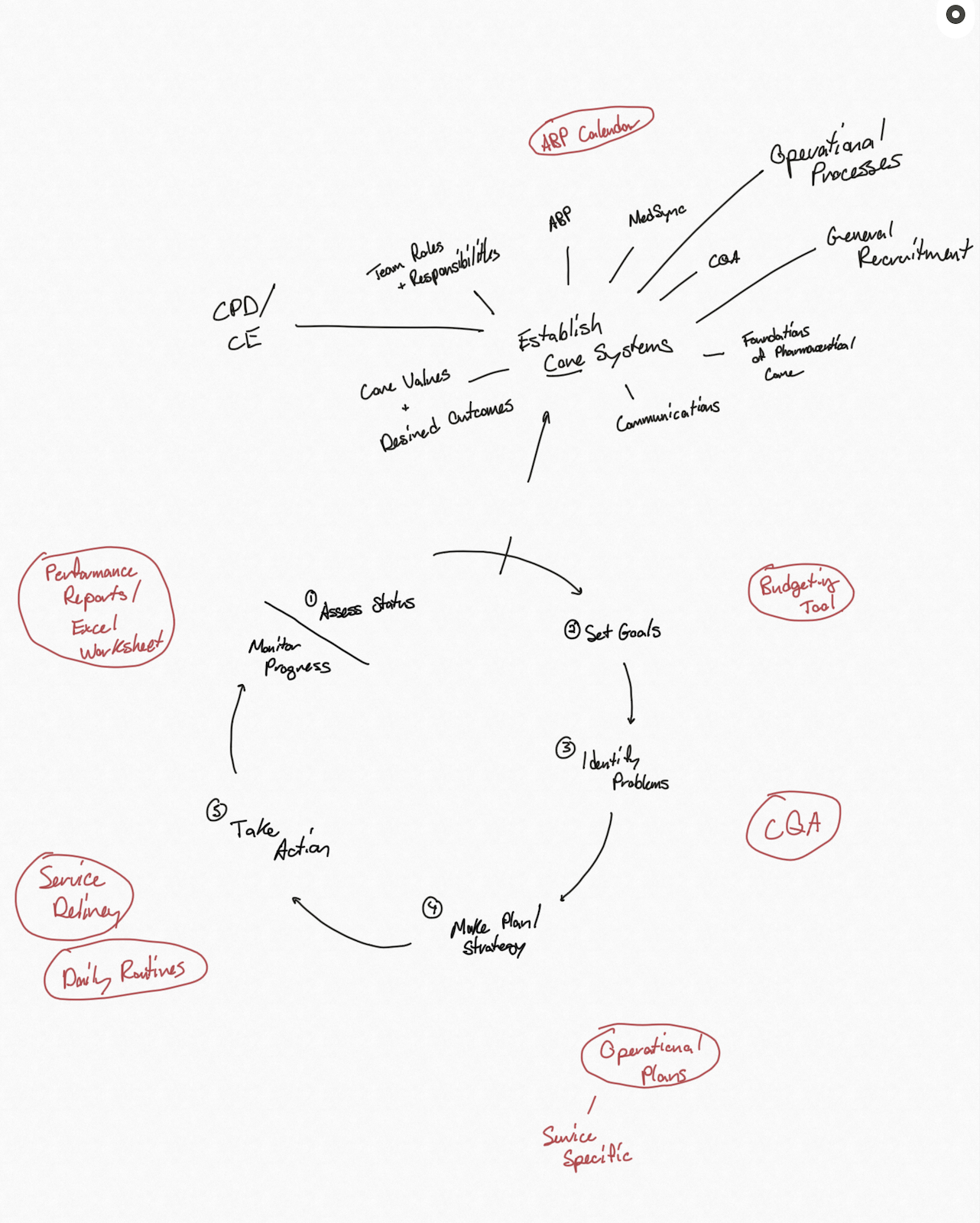
            <p><em>Non-dispensing services (NDS)</em> are pharmacy services that are not directly associated with the dispensing of medications. It includes services like medication reviews, common ailment prescribing, medication renewals, injection services, etc. It doesn't include prescription verification, routine patient counselling, etc.</p>

            <p>Operationalizing non-dispensing pharmacy services can be challenging. Often, we think of a service that a patient would benefit from during routine dispensing — but with no opportunity or time to deliver that service in the same moment.</p>

            <p>By taking a more proactive and intentional approach to non-dispensing services we can take better note of those opportunities and then deliver the services when resources and circumstances allow.</p>

            <p><strong>To support successful integration of non-dispensing services, we can reflect on the following:</strong></p>

            <ul>
                <li>When is it possible to deliver services? (What times are OK for booking/service delivery?)</li>
                <li>What services are offered at the pharmacy?</li>
                <li>What services are covered by third party payers?</li>
                <li>What are the standards of practice and documentation requirements associated with the available services?</li>
                <li>What is the team's familiarity and comfort level with promoting and delivering the available services?</li>
                <li>What practice supports exist to support the efficient delivery of NDS (e.g. forms, quick-references, drug file notes, etc.)</li>
                <li>What are the team's goals for delivery of NDS?</li>
                <li>Does the team have a way to track progress and performance?</li>
                <li>What is the team's strategy for delivering NDS and meeting shared goals?</li>
                <li>How do the various pharmacy roles work together to support the delivery of NDS?</li>
                <li>Does the team have a quality improvement system (a way to capture problems with the system to improve things over time)?</li>
                <li>How does the team celebrate meaningful milestones?</li>
                <li>... and more.</li>
            </ul>

            <h2>The Primary Toolkit:</h2>

            <ul>
                <li><strong>Appointment-Based Pharmacy Worksheet</strong> (Determine when services can be booked; establish capacity)</li>
                <li><strong>NDS Budgeting &amp; Planning Tool</strong> (Determine monthly NDS goals, working with the blocks available from the ABP Worksheet)</li>
                <li><strong>Operational Plans</strong> (The team's strategy for delivery of various NDS)</li>
                <li><strong>Performance Tracking System</strong> (Determine actual NDS delivery for comparison with team goals)</li>
                <li><strong>Continuous Quality Assurance (CQA)</strong> (A system for capturing and managing system-related problems associated with dispensing and NDS; broader than pharmacy error-reporting/ISMP)</li>
            </ul>

            <h2>Supportive Tools &amp; Tactics</h2>

            <ul>
                <li><strong>Pharmacy Management Software Mastery</strong> - Progressive skill-building and utilization of the features available within the pharmacy software to support effective and efficient pharmacy services delivery (dispensing and NDS).</li>
                <ul>
                    <li><a href="https://brandontoner.ca/krollcomments">Using Custom Kroll Comment Topics to Support Non-Dispensing</a></li>
                </ul>
                <li><strong>MedSync</strong> - Assists with relieving time-sensitive demands on the dispensary workflow and positions the pharmacy for more proactive care opportunities</li>
                <li><strong>General Recruitment Strategy</strong> - Basic training on how to promote NDS</li>
                <li><strong>Organizational Values</strong> - A shared team identity</li>
                <li><strong>Foundations of Pharmaceutical Care</strong> - Basic training on the structure of the Patient Care Process and how it relates to NDS</li>
                <li><strong>Continuing Professional Development (CPD)</strong> - A system to support the continuous management of learning objectives to address self-identified learning needs in pursuit of a professional ideal</li>
            </ul>
            <figure>
                <img src="https://brandontoner.ca/images/facilitation_overview.png" alt="NDS Facilitation Overview">
                <figcaption>Overview of the NDS Facilitation Process</figcaption>
            </figure>
        ]]>
    </content>
</entry>
<entry>
        <id>https://brandontoner.ca/krollcomments</id>
        <link href="https://brandontoner.ca/krollcomments"/>
        <title>Using Custom Kroll Comment Topics to Support Non-Dispensing Services</title>
        <published>2023-06-06T06:00:00-04:00</published>
        <updated>2023-06-06T06:00:00-04:00</updated>
    <content type="html">
        <![CDATA[
            <p><strong>&quot;Comments&quot; are a powerful tool in Kroll.</strong> </p>

            <p>Most pharmacy teams use comments to make notes on patient files, drug files, doctor files, prescription files, etc. Where they become <em>very</em> powerful, though, is when you start to create <strong>custom comment topics</strong>, use those to document different types of information, and then generate <em>reports</em> to find instances of that note topic across your database.</p>

            <p><strong>A few useful note topics:</strong></p>

            <ul>
                <li><em>NDS Overview</em> - template; for keeping track of service offers and dates of last service delivery for various services</li>
                <li><em>NDS Opportunity</em> - for documenting NDS that the patient may be a good candidate for/benefit from</li>
                <li><em>Update Needed</em> - for documenting (and resolving) information gaps.</li>
                <li><em>pDTP</em> - For documenting <em>potential</em> drug therapy problems</li>
                <li><em>OTC Medication</em> - For keeping track of non-prescription products the patient uses</li>
                <li><em>Smoking Status</em> - For documenting smoking status</li>
            </ul>

            <p>Any custom comment topics must be added into Kroll's &quot;Lists&quot;. There is a master topics list in there... I forget the specific name.</p>

            <p>Once they are built in, they should auto-complete based on typing the first few characters, and should be available for reporting.</p>

            <p><strong>Why this matters makes more sense with an example...</strong></p>

                <p>E.g. The <em>&quot;Update Needed&quot;</em> Comment Topic (one of my favourites)</p>

                <p>Often, while dispensing, you may notice that a particular piece of information is missing, outdated, or would benefit from verification — but most frequently <em>&quot;now is not the best time to do that&quot;</em>. So we ignore it... until later... </p>

                <p>With this comment topic, you can note the update that is needed &quot;update phone number&quot;, &quot;allergies?&quot;, &quot;indication for nortriptyline&quot;, etc.</p>

                <p>You can also place a &quot;Workflow Alert&quot; on the comment so that it flags at the appropriate context (e.g. during &quot;pickup&quot; or &quot;clinical verification&quot;).</p>

                <p>And periodically, a team member could run the &quot;Update Needed&quot; comment report, and proactively call patients to batch-clarify the missing information.</p>

                <p>By creating good habits around using, resolving, and reporting on these information gaps you will be able to improve and maintain the quality of information throughout your pharmacy database.</p>

                <p><em>... which is an important component of effectively identifying potential drug therapy problems and service opportunities.</em></p>

            <p>There are some significant possibilities here. </p>

            <p><strong>Important elements:</strong></p>

            <ul>
                <li>Whole team understands the values, how to document this way, and regularly uses core comment topics.</li>
                <li>Learning how to recognize opportunities to use custom comment topics.</li>
            </ul>

            <h3>See also:</h3>
            <ul>
                <li><a href='/nds'>Integrating Non-Dispensing Services into Routine Pharmacy Workflow</a></li>
                <li><a href='/pdtp'>Using Potential Drug Therapy Problems (pDTP) to Prime for Care Planning Services</a></li>
            </ul>
            
            <hr>

            <h3>Future Writing</h3>

            <ul>
                <li>Using the <em>NDS Overview</em> Comment to Track NDS &quot;Offers&quot; and &quot;Last Service&quot; dates</li>
                <li>Using <em>Patient Groups</em> to manage NDS program participants and service candidates</li>
                <li>How a shared documentation strategy enhances pharmacy efficiency and care delivery — creating a shared language.</li>
                <li>Documenting reusable bits of information.</li>
                <li>How &quot;Profile Completeness&quot; makes the delivery of pharmacy services easier and more effective.</li>
            </ul>
        ]]>
    </content>
</entry>
<entry>
        <id>https://brandontoner.ca/krollfollowup</id>
        <link href="https://brandontoner.ca/krollfollowup"/>
        <title>Prescription Follow-up in Kroll</title>
        <published>2023-06-05T08:00:00-04:00</published>
        <updated>2023-06-05T08:00:00-04:00</updated>
    <content type="html">
        <![CDATA[
            <p>The following are instructions for scheduling a follow-up activity for a prescription in Kroll. This could be applied to follow-up on a pharmacy service processed with a prescription number as well.</p>

            <h3>Scheduling Follow-Up</h3>

            <ol>
            <li>Select &quot;Counsel Rx&quot; for the prescription in one of two ways.

            <ul>
            <li>From the Start Screen (Alt-x), enter the Rx Number and select &quot;Counsel Rx&quot;</li>
            <li>From the Patient Profile (F3), select the Rx → Extra Functions → &quot;Counsel Rx&quot;</li>
            </ul></li>
            <li>Type &quot;Scheduling Follow-up&quot; in the comments along with any particular details of the Monitoring Plan.</li>
            <li>Click on the &quot;Follow-Up&quot; button on the right and enter a follow-up date. <em>The activity will now appear in the Follow-Up tab on the Kroll Start Screen</em></li>
            </ol>

            <h3>Completing the Follow-Up</h3>

            <ol>
            <li>On the day of the follow-up, double click the patient's name to launch the activity. The Counsel Rx module will open.</li>
            <li>Review the Monitoring Plan or any notes left by going to the Patient Profile and selecting &quot;Rx Counselling History&quot;. The PhC may review the any documentation in the Images tab as applicable (e.g. pharmacy service)</li>
            <li>If the patient is not available, enter a note in the Comments field (e.g. “N/A First Call” or “N/A Third Call – Lost to follow-up”) and reschedule the follow-up if warranted (i.e. click on Follow-Up and enter a new date). Finalize the Counsel Rx as a new record will be generated with the new Follow-Up date.</li>
            </ol>

            <p>Once completed, the follow-up can be retrieved by viewing the Rx Counseling Tab for the billing of the prescription or pharmacy service.</p>
        ]]>
    </content>
</entry>
</feed>